| MOQ: | 1Ton |
| Price: | 800-1000 USD/Ton |
| Standard Packaging: | In bundles or in wooden boxes. |
| Delivery Period: | 20-30days upon products |
| Payment Method: | L/C,D/A,D/P,T/T |
| Supply Capacity: | 60000 Ton/Tons per Year |
![]()
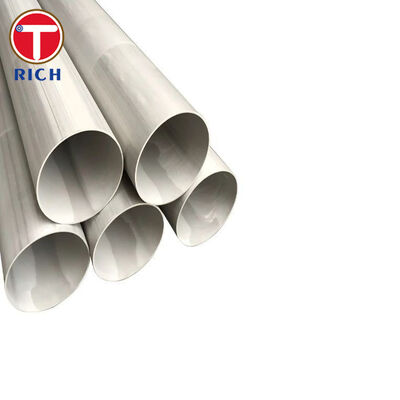
DP600 Dual-Phase Steel ERW Tubes are developed for automotive headrest support structures requiring high strength, good formability and reliable welded tube construction. Manufactured from cold-rolled DP600 steel strip through electric resistance welding (ERW), these tubes feature reference outer diameters of 10–14 mm and wall thicknesses of 1.2–2.0 mm. They are suitable for evaluating automotive seat support components involving tube bending, cutting, flattening and assembly.
|
Item |
Specification |
|---|---|
|
Product Name |
DP600 Dual-Phase Steel ERW Tube |
|
Material / Grade |
DP600 Dual-Phase Steel |
|
Reference Grade |
CR330Y590T-DP |
|
Applicable Material Standard |
VDA 239-100 |
|
Manufacturing Process |
Cold-Rolled Strip Forming + ERW Welding |
|
Outer Diameter (OD) |
10–14 mm |
|
Wall Thickness (WT) |
1.2–2.0 mm |
|
Inner Diameter (ID) |
According to OD and WT combination |
|
Length |
Cut to drawing requirements |
|
OD Tolerance |
According to customer drawing |
|
WT Tolerance |
According to customer drawing |
|
Length Tolerance |
According to customer drawing |
|
Surface / Finish |
Uncoated steel tube; additional surface treatment subject to specification |
|
Delivery Condition |
ERW welded, sized and cut to length |
|
Inspection / Testing |
Dimensional inspection, visual inspection and agreed weld seam testing |
Note: OD and WT are application-based reference dimensions. Not every OD and WT combination is necessarily available. Final dimensions and tolerances require drawing review and manufacturing validation.
1. High Strength for Automotive Seat Structures
DP600 dual-phase steel offers a tensile strength of 590–700 MPa for the reference CR330Y590T-DP grade. Its high strength supports the design of compact tubular components used in automotive seat structures.
2. Good Formability for Tube Processing
The ferrite-martensite microstructure combines formability with strength. This material characteristic supports subsequent cold forming operations, including bending and shaping, subject to process validation.
3. ERW Welding for Consistent Tube Construction
The ERW process forms a longitudinal welded seam. Proper control of strip forming, welding parameters and sizing helps maintain tube geometry and weld seam consistency.
4. Suitable for Precision Headrest Support Components
The 10–14 mm OD and 1.2–2.0 mm WT reference dimensions provide a starting point for automotive headrest tube design, supporting compact structural components and downstream assembly.
DP600 steel strip is inspected before tube production to verify material identification, thickness and surface condition.
During ERW manufacturing, strip forming, edge alignment and welding parameters are controlled to maintain tube geometry and longitudinal weld seam quality.
After welding, the tubes undergo sizing, straightening and cutting according to the required dimensions. Additional processing can include bending, flattening, notching and end forming, depending on the component drawing.
Quality inspection can include:
OD and WT dimensional measurement.
Length and straightness inspection.
Ovality measurement.
Weld seam visual inspection.
Eddy current testing when specified.
Flattening and bending tests according to the agreed inspection plan.
DP steel is sensitive to additional heat treatment above 200°C. Post-weld thermal processing should therefore be evaluated carefully against the selected material specification.
1. Controlled ERW Manufacturing
Buyer Concern: Variations in the welded seam can affect subsequent tube forming and component assembly.
TORICH Approach: Review strip forming, welding and sizing requirements to establish appropriate process controls.
Practical Benefit: More consistent tube geometry and weld seam quality for downstream automotive processing.
2. Drawing-Based Tube Processing
Buyer Concern: Headrest tubes require accurate dimensions and forming positions to fit seat assembly components.
TORICH Approach: Evaluate cutting, bending, flattening and end-forming requirements against customer drawings.
Practical Benefit: Reduced coordination between tube supply and subsequent component manufacturing.
3. Application-Oriented Inspection
Buyer Concern: Dimensional variation or weld defects may create problems during assembly.
TORICH Approach: Establish inspection requirements around critical OD, WT, length and weld seam characteristics.
Practical Benefit: Clearer dimensional acceptance criteria and more controlled incoming material inspection.
|
Standard |
Relevant Grade / Scope |
Notes |
|---|---|---|
|
VDA 239-100 |
CR330Y590T-DP |
Reference material specification for DP600 cold-rolled steel |
|
Customer Drawing |
Finished ERW Tube |
Defines OD, WT, length, tolerances and component requirements |
|
OEM Specification |
Automotive Headrest Components |
Additional material, testing and acceptance requirements where applicable |
Reference Chemical Composition – CR330Y590T-DP (Uncoated)
|
Steel Grade |
C (max) |
Si (max) |
Mn (max) |
P (max) |
S (max) |
Al |
Nb+Ti (max) |
Cr+Mo (max) |
B (max) |
Cu (max) |
|---|---|---|---|---|---|---|---|---|---|---|
|
CR330Y590T-DP |
0.12 |
0.40 |
1.60 |
0.025 |
0.010 |
0.015–1.50 |
0.10 |
1.00 |
0.005 |
0.20 |
Unit: wt.%
Reference Mechanical Properties – CR330Y590T-DP
|
Property |
Specification |
|---|---|
|
Yield Strength (Rp0.2) |
330–430 MPa |
|
Tensile Strength (Rm) |
590–700 MPa |
|
Elongation (A80) |
≥20% |
|
Test Direction |
Longitudinal (L) |
|
Material Standard |
VDA 239-100 |
These values refer to the incoming flat steel strip. Finished ERW tube properties, particularly around the weld seam and heat-affected zone, require separate evaluation.
DP600 ERW tubes are intended for automotive headrest support structures connecting the headrest assembly to the vehicle seatback.
During component manufacturing, the tubes may undergo cutting, bending, flattening, notching and joining operations. Dimensional consistency is important for maintaining alignment, height adjustment and assembly fit.
Key inspection points include:
Tube OD and WT consistency.
Tube straightness and ovality.
Bending deformation and dimensional recovery.
Weld seam integrity.
Notch position and assembly dimensions.
These factors help automotive seat manufacturers control component fit and production consistency.
1. What are the typical dimensions of DP600 automotive headrest tubes?
A market reference range is OD 10–14 mm with wall thicknesses of 1.2–2.0 mm. Final dimensions depend on the headrest design and manufacturing feasibility.
2. Can DP600 ERW tubes be bent after welding?
Yes, bending can be evaluated based on tube diameter, wall thickness, bending radius and weld seam position. Trial forming is recommended before mass production.
3. Can DP600 tubes be supplied with customized lengths?
Yes, cut-to-length requirements can be specified according to the component drawing. Required tolerances should be agreed before production.
For DP600 ERW automotive headrest tubes, please provide:
Material Grade: DP600 / CR330Y590T-DP
Material Standard: VDA 239-100
Outer Diameter: 10–14 mm
Wall Thickness: 1.2–2.0 mm
Required Length
OD / WT Tolerances
Surface Treatment Requirements
Bending or Notching Requirements
Annual or Trial Order Quantity
Technical Drawing and Application
![]()
![]()
![]()
![]()
![]()
![]()
A: manufacturer,also can do trading.
A: Generally speaking,it is 10-15 days if the goods are in stock,or it is 30-40 days if the goods are not in stock,
it is according to quantity.
A: Yes, we could offer the sample for free charge but need pay the cost of freight.
A: Payment<=2000USD, 100% in advance. Payment>=2000USD, 30% T/T in advance ,balance before shippment.
If you have another question, pls feel free to contact with me.